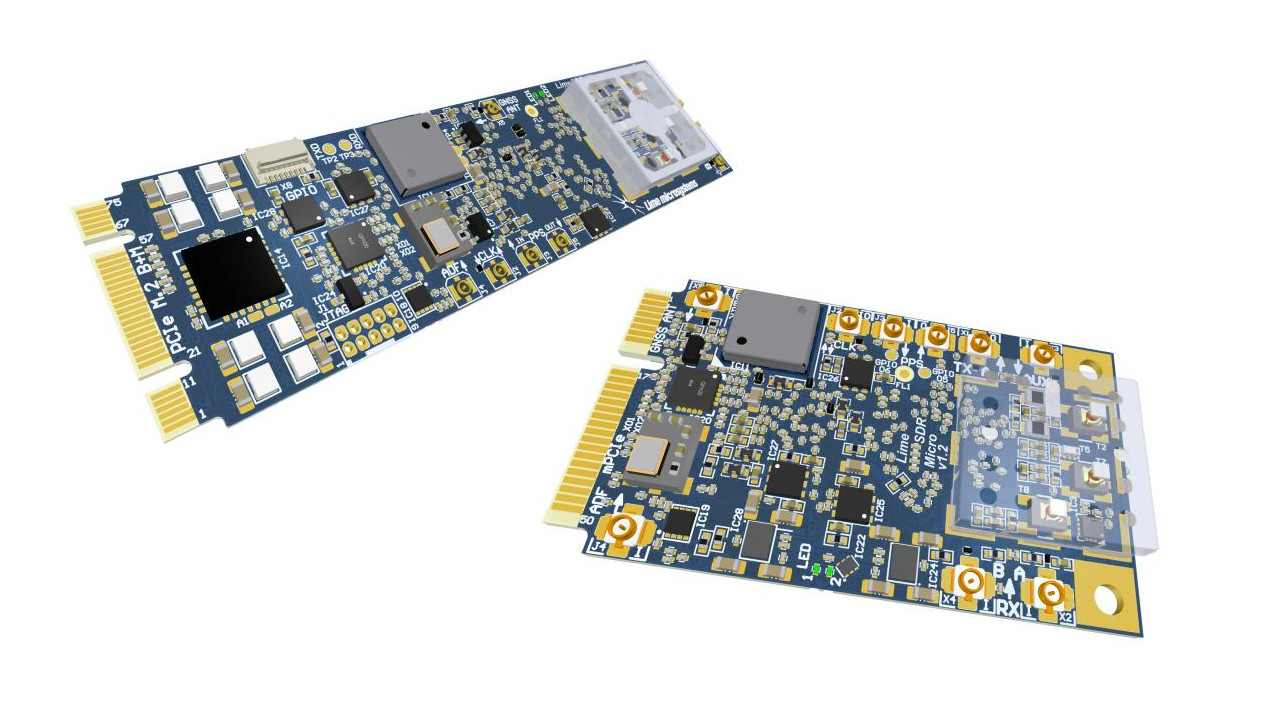
Lime Microsystems has been working on a new, low-cost entry in the LimeSDR family of software-defined radio devices: the LimeSDR Micro, designed to fit into M.2 and mini-PCI Express (mPCIe) slots.
“LimeSDR Micro represents a breakthrough in software-defined radio technology, delivering professional-grade SDR with integrated baseband processing,” the company says of the new entry in the family. “This innovative design enables seamless integration into embedded systems while maintaining the power and flexibility demanded by modern wireless applications. Powered by the NXP LA9310 baseband processor and Lime Microsystems LMS7002M RF transceiver, it provides a flexible and powerful platform for developing wireless systems and solutions. Designed for seamless integration with a wide range of host platforms, it supports applications across narrowband and broadband air interfaces.”
The Lime Micro LMS7002M on the board is the same as you’ll find on other LimeSDR models. The NXP LA9310 programmable baseband processor, meanwhile, features integrated 12-bit analogue to digital and digital to analogue converters (ADC/DAC) operating at up to 160 mega-samples per second and a VSPA digital signal processor (DSP) with ~80 gigaFLOP performance for on-device real-time signal processing.
The board will launch in M.2 2280 and mini-PCI Express variants, and is supported by open-source firmware and the same open-source software stack as the rest of the LimeSDR family. For more information, and to sign up to be notified when the campaign goes live, see the LimeSDR Micro Crowd Supply page.
Daniel Estévez has published a write-up of his work decoding and analysing signals from the Lunar GNSS Receiver Experiment (LuGRE) – an effort to see if a Global Navigation Satellite System (GNSS) could be used for position finding on the moon.
“The Lunar GNSS Receiver Experiment (LuGRE) is a NASA and Italian Space Agency payload that flew in the Firefly Blue Ghost Mission 1 lunar lander,” Daniel explains. “The payload contains a Qascom GPS/Galileo L1 + L5 receiver capable of both real time positioning and raw IQ recording, and a 16dBi high-gain antenna that was pointed towards Earth. For decades the GNSS community has been talking about using GNSS in the lunar environment, and LuGRE has been the first payload to actually demonstrate this concept.
“The LuGRE payload ran a total of 25 times over the Blue Ghost mission duration, starting with a commissioning run on 2025-01-15 a few hours after launch and ending with a series of 9 runs on the lunar surface between 2025-01-03 (the day after the lunar landing) and 2025-01-16 (end of mission after lunar sunset). For a first analysis, I have implemented a high-sensitivity acquisition algorithm for the GPS L1 C/A signal in [Nvidia’s] CUDA. I have run this on all the 20 L1 IQ recordings that are available.
“There is a receiver frequency drift problem in most of the recordings,” Daniel warns. “This affects the sensitivity of the acquisition algorithm, so it is possible that some weaker signals have not been detected because of this. Out of 19 recordings, signals can only be detected in 12 of them. The number of satellites in each of these 12 recordings ranges between 1 and 3.”
The full write-up is available on Daniel’s website, while the code is available on GitHub under the permissive MIT licence. Those looking to try analysis for themselves can find the data on Zenodo.
NASA has announced that it has lost connection to the Mars Atmosphere and Volatile EvolutioN (MAVEN) spacecraft, currently in orbit around Mars – despite all systems reporting normal operations prior to signal loss.
“NASA’s MAVEN (Mars Atmosphere and Volatile EvolutioN) spacecraft, in orbit around Mars, experienced a loss of signal with ground stations on Earth on Dec. 6. Telemetry from MAVEN had showed all subsystems working normally before it orbited behind the Red Planet,” NASA explains in its announcement. “After the spacecraft emerged from behind Mars, NASA’s Deep Space Network did not observe a signal.
“Although no spacecraft telemetry has been received since Dec. 4, the team recovered a brief fragment of tracking data from Dec. 6 as part of an ongoing radio science campaign. Analysis of that signal suggests that the MAVEN spacecraft was rotating in an unexpected manner when it emerged from behind Mars. Further, the frequency of the tracking signal suggests MAVEN’s orbit trajectory may have changed. The team continues to analyze tracking data to understand the most likely scenarios leading to the loss of signal. Efforts to re-establish contact with MAVEN also continue.”
MAVEN launched in November 2013, reaching Mars’ orbit in September 2014. Its payload is designed to explore the planet’s upper atmosphere, ionosphere, and investigate its interactions with solar winds in an effort to discovery the cause of Mars’s atmospheric loss – while also doubling as a relay for communication with Mars rovers.
More information on MAVEN is available on the NASA website.
The Osmocom project has announced a new release of the Cellular Network Infrastructure (CNI) software stack, its second – and last – of the year.
“The Osmocom project has released new version 202512 of the CNI (Cellular Network Infrastructure) software,” Osmocom’s Pau Espin wrote in the release announcement this month, “including OsmoTRX, OsmoBTS, OsmoPCU, OsmoBSC, OsmoMGW, OsmoMSC, OsmoHLR, OsmoSGSN, OsmoGGSN, OsmoSTP, OsmoSIPConnector, and others.”
The Osmocom CNI is designed to provide an open-source software stack for GSM/3GPP cellular communication, typically deployed using a software-defined radio (SDR) to create flexible base stations. The latest release comes with a range of new features and bug fixes, though also with one key change: the official cessation of support for running on big-endian systems, which will now abort during the configuration stage.
Other changes include the first tagged release of libosmo-asn1-tcap, which provides a public application programming interface to decode and free the contents of the TCAP_Message variable – used by libosmo-sigtran to perform traffic load-sharing – along with a major refactoring of the code in libosmo-sigtran itself, a compatibility fix in OsmoTRX, a fix for building OsmoBSC on Debian 13 running atop ARMv7L hosts, optimisations in osmo-upf, and tweaks to the documentation.
A full list of changes is available in Pau’s announcement.
Researchers at the Julius-Maximilians University Würzburg Johannes Kepler University Linz have announced their participation in the Tiny Tapeout project – submitting a chip design for a transmission-capable WSPR radio dubbed TinyWSPR.
“We (JKU Linz and JMU Würzburg) built a fully WSPR-capable TX on open-source silicon (TT-Sky25b via Tiny Tapeout),” say the team of their project. “A digital subsystem generates symbols; an analogue RF chain performs IQ modulation. FPGA tests already reached central Europe with just 10mW on 40m. Now we’re waiting for the chip from the fab for the first on-air tests.”
The Tiny Tapeout project aims to make it possible to build custom silicon chips in-hardware at a fraction of the usual cost, using free and open-source process design kits (PDKs) to submit many small projects for production into a single multi-project chip – thus splitting the cost between all participants. Each chip contains a copy of all the projects submitted for that production run, with the latest to include TinyWSPR.
“Next tapeout is already submitted with a RISC-V [processor] that implements Taylor modes in software,” notes Matthias Jung of his team’s plans for the project. “We also need a[n] RX path in the future.”
More information is available in the team’s Mastodon post.
The SWLing Post has published a low-cost simple ferrite rod antenna design, submitted by Giuseppe Morlè – designed for mediumwave operation but which also “performs well on shortwave,” according to its creator.
“Inside the tube at the top are two 12cm ferrite rods with 32 turns of telephone wire wrapped around them,” Guiseppe explains of the T-shaped antenna. “This section is for mediumwave. Then, on the outside of the tube, I added four more turns for shortwave. A variable capacitor of about 1000 pF completes the circuit.
“Shortwave is activated with an alligator clip. When the clip is removed, only the mediumwave section is active. I tested this antenna with my old Trio 9R-59DS from the 1970s—a tube receiver still in perfect condition. To my pleasant surprise, the receiver paired beautifully with the antenna.
“These tests were done on mediumwave in the early afternoon yesterday while it was still light outside. With the antenna placed above the receiver inside my shack, I was able to receive stations from across the Mediterranean basin and Eastern Europe, even in areas where the sun had already set. I really enjoy testing this antenna before evening, and I’m very satisfied with its performance.”
The full write-up is available on the SWLing Post blog, with a supporting video available on YouTube.
Maker Mirko Pavleski has designed an easy-to-build two-component variable frequency oscillator (VFO), designed with an eye for classic aesthetics but with very modern components.
“Today I received a shipment with a Small round LCD display from Elecrow: [a] CrowPanel 1.28”-HMI ESP32 Rotary Display 240×240, which has some really impressive features: high-performance ESP32-S3 chip; Wi-Fi and low-power Bluetooth; capacitive touch screen with knob; five WS2812 RGB LEDs; and the rotary encoder in the form of a circular ring.
“This is my first time encountering this display, so I decided to use it to create a device that would demonstrate all of its features. Otherwise, as a passionate shortwave listener, I was impressed by the original idea of T Uebo from TJlab for making a VFO with virtual retro circular scales.
“The circular shape of this display is ideal for making such a device, so I decided to make a similar but also useful and functional device based on the previously mentioned project. The fact that this display contains a built-in rotary encoder, buttons and a touch screen makes it even more usable for this purpose. Also very important is the fact that we only need to solder a few wires to make a fully functional VFO so that even a beginner in this field can easily make it.”
Those few wires connect the only two components in the system, bar a battery, power switch, and signal socket: the rotary display and a clock generator module breakout board. Everything is installed in a compact box, with the rotary display acting as the human interface device.
The full project write-up is available on Hackaday.io.
Finally, mononymous radio ham and YouTuber Rob of the Frugal Radio channel has shown how you don’t have to break the bank to experiment with software-defined radio – by using ex-corporate desktops advertised for just $25 each to drive a station running eight SDR dongles.
“Quick myth bust: you don’t need to spend $2,000 on a beast of a PC to run SDRs like a pro. Proof: I’ve snagged five Dell Optiplex small form factor PCs advertised at just $25 each,” Rob says in his latest video. “And wait till you hear the insane price I actually paid. These little powerhouses run multiple SDR decoders at once, power three displays each, and fit perfectly in my setup without hogging space and blowing up my electricity bill.
“Meet SDR Opt1, the $25 sentinel that never sleeps,” Rob says of one of the systems he’s put together. “Right now, it’s decoding five digital trunk networks across my city. It’s doing that 24/7. Each control channel locked, monitored fulltime using five inexpensive [software-defined radio] dongles. Why? Because this is where the real city talks. Security firms barking orders, couriers dodging traffic, malls on lockdown, charter buses rolling VIPs, warehouses moving millions in freight, even rental radios popping up at every festival, concert, and street fair. Need to eavesdrop on a weekend rave or outdoor market? This is ground zero.”
The full video is available on the Frugal Radio YouTube channel now, including the big reveal on just how much Rob spent on the machines.