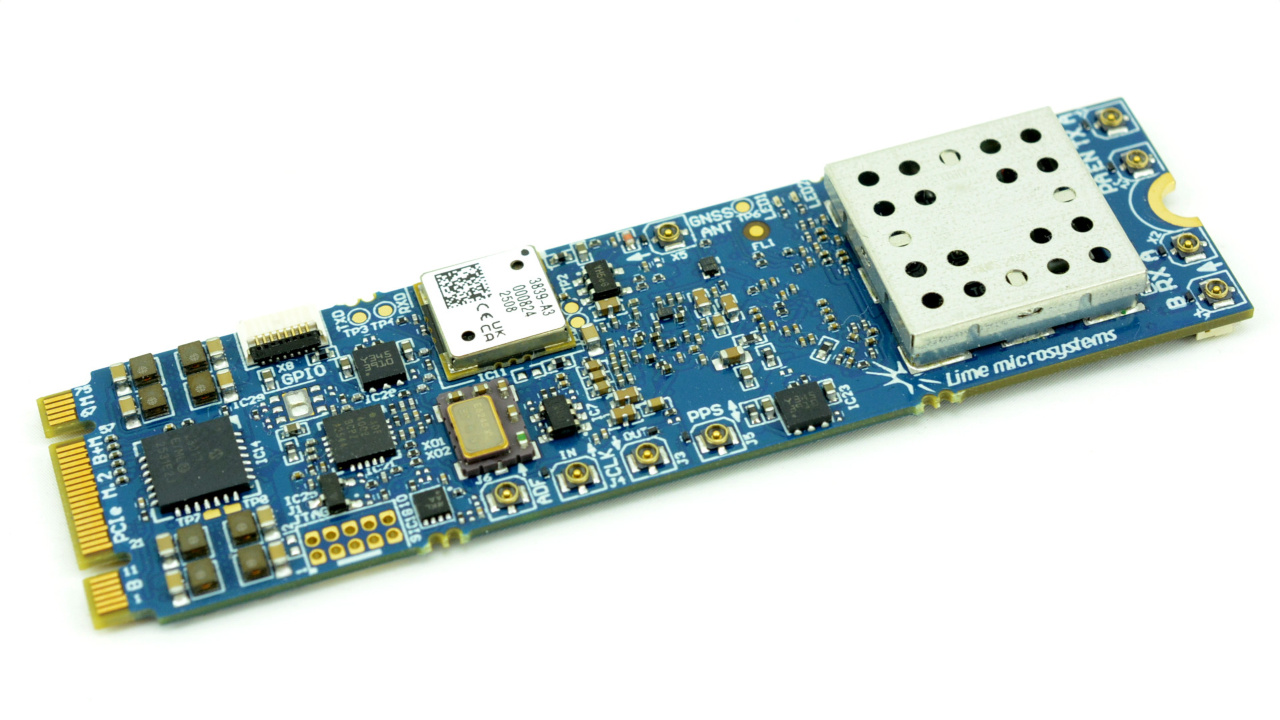
Lime Microsystems has opened a crowdfunding campaign for the latest entry in the LimeSDR family of software-defined radios: the LimeSDR Micro, a two-in-one M.2 module capable of acting as a traditional software-defined radio and/or as an accelerator for signal processing.
The LimeSDR Micro is based on the Lime Micro LMS7002M, giving it a frequency range of 30MHz to 3.8GHz with a one-transmit and two-receive (1T2R) setup – expandable to one transmit and four receive (1T4R) through on-board analogue baseband inputs. It offers 100MHz bandwidth in time-division duplex (TDD) mode or half-duplex operation, with 50MHz frequency-division duplexing (FDD). There’s an on-board temperature sensor, four general-purpose input/output (GPIO) pins with access to a shared I2C bus, and a 30.72MHz VCTCXO clock with reference input and output connections.
What there isn’t is a field-programmable gate array (FPGA). Unlike other models in the LimeSDR family, the LimeSDR Micro is designed as an “all software programmable” radio – meaning, Lime Micro explains, there’s no need for FPGA development experience. In its place is the NXP LA9310 ultra-low-power baseband processor, which includes a vector signal processor accelerator (VSPA) – usable as either a coprocessor for the host system or to handle signal processing tasks on-device.
“NXP also provide a collection of open source VSPA kernels for functions such as FFT, inverse FFT, CRC generation, FIR filters, mixer, and modulation/demodulation of up to 1024-QAM,” Lime Micro adds of the chip’s capabilities. “With selected kernels accompanied by Matlab scripts for generating test vectors. The DSP kernels may be used to both extend the default firmware and in the creation of entirely new firmware, which might implement physical layer processing for a particular wireless standard, for example.”
As with all LimeSDR models, the new LimeSDR is open-source: schematics, board layouts, manufacturing files, and the complete design database will be published during the device’s crowdfunding campaign, Lime Micro has promised, while the control and digital signal processing firmware are already available on GitHub under the permissive BSD three-clause licence.
The LimeSDR Micro isn’t alone, either: the company has announced the LimeFEA HF Micro add-on, which adds a third receive path with a 0-30MHz frequency with a direct sampling architecture which, Lime Micro says, “essentially captures the entire HF frequency range” at once. The LimeSDR Micro Pro, meanwhile, puts the LimeSDR Micro and a LimeFEA HF Micro into a metal enclosure with USB 4.0 connectivity.
The LimeSDR Micro crowdfunding campaign is live on Crowd Supply now, with pricing starting at $199 for “early bird” backers of the LimeSDR Micro M.2 2280 rising to $249 without or $299 with Global Navigation Satellite System (GNSS) receiver; the LimeFEA HF Micro is an extra $199, with the LimeSDR Micro Pro priced at $749.
Ham radio operator and full-stack developer Vlad “EA1FUO” Goia has released a browser-based antenna simulator, having found existing offerings either limited in compatibility or outright abandoned.
“I wanted for some time to build my own antennas and I couldn’t find any fitting software for me,” Vlad explains. “What I found on the internet was: MMANA [which hasn’t been updated since 2009; EZNEC [which] is gone; 4NEC2 [which] is Windows only. Mac and Linux users get Wine and prayer and even Windows has very old software for this matter. I’m a ham (EA1FUO) and a full-stack developer, so I decided to build what I wished existed: a modern, free, open-source antenna simulator that runs in my browser with a real NEC2 engine.
“What’s working. 15+ antenna templates: (dipole, yagi, EFHW, vertical, quad, moxon, magnetic loop…) with real-time 3D preview. Full wire editor: design any antenna from scratch, drag endpoints in 3D, spreadsheet wire table, undo/redo, import from templates to avoid reinventing the wheel. NEC2 power: loads, traps, transmission lines, Sommerfeld ground, multiple sources… 3D radiation pattern: now we are able to rotate and explore, current distribution on wires, near-field heatmap. SWR, impedance, Smith chart, polar plots: all the charts we need to understand our antenna. Import .maa / .nec / .s1p: bring our MMANA designs and NanoVNA measurements. Optimizer: auto-tune for best SWR, gain, or F/B by selecting what wire variables we would like to change and in what ranges.
“[The software has] two deployment modes,” Vlad notes. “Self-hosted with Docker (backend + Redis) or fully static via WebAssembly on GitHub Pages – zero server required. Contributions are welcome. This is a free and open-source project for the amateur radio community.”
More information is available in Vlad’s Reddit post, while the project’s source code is available on GitHub under the reciprocal GNU General Public Licence 3. A live version is available to use via GitHub Pages, requiring no software installation and running directly in-browser.
Daniel Estévez has reported that Tianwen-1, the China National Space Administration mission to Mars, is once again transmitting telemetry after going silent for a few months.
“A few days ago I posted about the fact that AMSAT-DL had not received any signals from Tianwen-1 since 2025-12-23,” Daniel writes. “For months, AMSAT-DL had kept listening to the orbiter’s frequency with the 20m antenna in Bochum and had not detected any signals. Yesterday, AMSAT-DL announced that they had received again the signal from Tianwen-1.
“Telemetry containing state vectors was decoded between 2026-03-17 11:34 and 14:16 UTC. I have updated my plot of orbital parameters to include this new information. The period between 2025-12-23 and 2026-03-17 corresponds to a propagation with GMAT of the last telemetry received in 2025. The end of the plot corresponds to the telemetry received in 2026-03-17.
“We can see that the orbit has remained the same, and there have been no manoeuvres during this period. A zoomed in version to the end of the plot shows that there is basically no jump in the orbital parameters. There is a tiny jump in the inclination as the new telemetry is received, but that is all. So far the reasons why Tianwen-1 has apparently not transmitted telemetry to Earth for almost three months remain unknown,” Daniel notes.
More information, including the plots, is available on Daniel’s website and in the AMSAT-DL Bluesky post.
Researchers from Space Engineering University, the Beijing Institute of Tracking and Telecommunications Technology, the Shanghai Astronomical Observatory of the Chinese Academy of Sciences, Henan Polytechnic University, Shandong University of Science and Technology, and Wuhan University have found a way to stabilise signal shifts in Global Navigation Satellite Systems (GNSS) – boosting robustness with nothing more than a software update.
“As a key method to enhance the anti-jamming capability of Global Navigation Satellite System (GNSS), flex power technology enables ground-based commands to dynamically adjust satellite signals by redistributing signal components, thereby strengthening specific transmissions and improving service robustness in interference environments,” the researchers explain. “Both the Global Positioning System (GPS) and the BeiDou Navigation Satellite System (BDS) support flex power functionality. Activating and deactivating of flex power can significantly impact the various aspects of GNSS performance and introduce new technical challenges.
“In this paper, we first analyse the flex power operational modes of GPS and BDS, then review existing detection methods to propose a novel detection approach applicable to both GPS and BDS. The proposed method employs carrier-to-noise density ratio (C/N0) and hardware delay as complementary indicators to achieve high detection accuracy with low false alarm rates. Subsequently, we investigate the impacts of flex power on cycle slip detection, code bias, satellite clock offset, phase bias, ionospheric corrections, and Precise Point Positioning (PPP).
“The results show that flex power affects several GNSS parameters with BDS exhibiting much greater sensitivity compared to GPS. To address these effects and advance resilient Positioning, Navigation, and Timing (PNT) theory, we propose the optimised estimation strategies for resilient code bias, satellite clock offset, and phase bias, along with an enhanced data processing framework for ionospheric modeling and PPP. The effectiveness of the proposed approaches is validated, demonstrating clear improvements in PNT service reliability. This study provides valuable insights and practical methodologies for enhancing the robustness of GNSS PNT services in flex power operations.”
The team’s algorithms, developed for code bias correction, satellite clock offset estimation, and phase bias modeling, are claimed to provide improved switching between normal and flex-power states, while ionospheric modelling accuracy is boosted by compensating for signal fluctuations ignored by existing approaches. The result: a software-only update which can deliver improved robustness against both environmental noise and active jamming attacks.
The team’s work has been published in the journal Satellite Navigation under open-access terms.
Turkish electronics firm Atek Midas has opened crowdfunding for the DSG-22.6 GHz, an open-source signal generator with a frequency range from 0.15 to 22.6GHz tunable at a 1Hz resolution.
“DSG-22.6 GHz is a low-cost, open-source RF signal generator that brings professional-grade performance into the hands of makers, engineers, and researchers,” says Suleyman Yasin Dundar of his company’s creation. “Existing RF generators at this frequency range are prohibitively expensive and bulky. DSG-22.6 GHz makes high-frequency testing, calibration, and research affordable, portable, and fully hackable.
“Unlike traditional bench instruments, DSG-22.6 GHz is powered by USB and includes a capacitive touchscreen. It also supports SCPI commands over USB and Wi-Fi, as well as a web interface, making it easy to control in the lab or the field using only a laptop or phone.
“Competing devices in the 22GHz range often suffer from poor spurious and harmonic suppression,” Suleyman claims of the devices the company is looking to beat. “DSG-22.6 GHz achieves excellent suppression while being an order of magnitude cheaper and more compact. This makes it ideal for bench work, production lines, and field applications.”
The signal generator offers a frequency range of 0.15-22.6GHz tunable in 1Hz steps, output power tunable in 1dB steps from +20dBm to -15dBm frequency-dependent, a claimed <100μs tuning speed, support for an external 10Mhz reference input, and built-in temperature, voltage, current, and phase-locked loop status diagnostics. Control is handled via a touchscreen display, a web interface served via Wi-Fi, or over USB with a Python-based user interface or SCPI control as options.
The project is funding on Crowd Supply now, priced at $1,590 with global shipping; schematics, 3D models, and firmware source code are all available on GitHub under an unspecified open-source licence.
Mononymous developer Ryan, also known as “idealdelay,” has released a tool designed to overhaul the visual appearance of GNU Radio Companion (GRC) — offering full control over theming, including a live preview function.
“I started out wanting the simplest thing imaginable in GNU Radio: a plain black background so my eyes could survive late-night debugging, and somehow that tiny request snowballed into a full-blown Geocities monstrosity with loud gradients, chaotic accents, and enough visual noise to make every flowgraph feel like a 1999 fan page,” Ryan explains of the project’s origins. “It is the definition of a first-world problem: I have powerful SDR tools, real technical work to do, and my biggest daily obstacle is that my interface now looks like it lost a fight with a glitter GIF archive, all because I tried to make one harmless cosmetic tweak.
“What [PimpMyGRC] does: replaces GRC’s stock look with fully themed colors, block rendering, connections, and ports. Includes a GTK4 theme switcher with a live animated preview so you can see exactly what you’re getting into before you commit. Themes are plain Python files that replace GRC’s canvas rendering modules (colors.py, block.py, connection.py, port.py). Originals are backed up on first run and can be restored at any time. Effects are stored in ~/.gnuradio/grc_effects.json and injected via patched DrawingArea.py and effects.py. No external dependencies beyond what GRC already ships with. Sound effects are synthesized in-memory and played via aplay.”
The tool comes complete with pre-configured themes including “neon-hacker” green-on-black, “phosphor” for a CRT terminal effect, “outrun” and “vaporwave” which evoke an 80s style, and “solarized-dark” for those already using Ethan Schoonover’s Solarized palette elsewhere. Animated visual effects include the digital-rain effect from The Matrix, ripples on mouse clicks, animated dots indicating data flow, connection gradients, port glow on mouse-hover, drop shadows, and even synthesised sound effects including sonar blips, coin noises, lasers, and more — all of which can be turned on and off at-will.
PimpMyGRC is available on GitHub now, under an unspecified open-source licence.
KrakenRF has opened crowdfunding for its Discovery Drive, a smart antenna rotator for satellite communication – designed primarily for use with its own Discovery Dish, though also compatible with any other similarly-sized antennas.
“Discovery Drive is a low-cost, turnkey, fully weatherproof, high-quality automatic Az/El (azimuth/elevation) antenna rotator designed for use with Discovery Dish and other antennas of similar size and weight, such as Yagi and Wi-Fi grid antennas,” says KrakenRF’s Carl Laufer. “A motorised rotator allows you to use a satellite dish or directional antenna to track and receive signals from polar orbiting satellites, which quickly move across the sky. It also lets you switch swiftly between geostationary satellites without manually realigning the dish. It’s also very easy to set up—no fiddling with expensive, separate controllers! Just connect Discovery Drive to 12V and Wi-Fi (or USB serial) and go!
“Discovery Drive enables precise tracking of fast-moving polar orbiting satellites using a satellite dish or directional antenna. Examples of polar orbiting weather satellites include METEOR-M2, METOP, and FENGYUN. Depending on your location, you may also have access to other interesting satellites that dump data over specific regions. Apart from public weather data, operators and enthusiasts might be interested in using Discovery Drive to track CubeSats, and amateur radio operators may wish to track amateur radio satellites. Amateur radio astronomy hobbyists can map the galaxy in the hydrogen line spectrum using Stellarium, or custom software to aim a Discovery Dish with H-Line feed, allowing you to scan multiple parts of the sky in one night.
“With Discovery Drive, all you need is a mast or tripod and your dish. Everything else is ready to go,” Carl claims. “Unlike other rotator systems that require you to 3D print parts, assemble complex kits, or solder electronics, Discovery Drive arrives fully assembled and ready to use straight out of the box. Simply mount it to your mast or tripod, attach your Discovery Dish (or a similarly sized antenna), connect to Wi-Fi, align to true north with your phone’s compass, and you’re ready to start tracking!”
The crowdfunding campaign is live on Crowd Supply now, priced at $699; YouTuber Gabe Emerson has also published a video review of a pre-release prototype, noting “some issues with cold weather” which will hopefully be ironed out by launch.
Finally, security researcher Trevor Unland has released RTL-ML — an automatic signal classifier based on a feature extraction machine learning algorithm and delivering a claimed 96.9% accuracy while running on a Raspberry Pi single-board computer or similar.
“Automatically identify radio signals using machine learning on a $220 hardware setup,” Trevor writes of the project’s aims. “96.9% accuracy classifying seven real-world radio signal types. $220 total hardware [cost]. No cloud, no GPU – runs entirely on ARM edge device. 800 validated samples with DC removal, SNR gating, and per-class quality checks. Temporal train/test split – no data leakage between train and test sets. Multi-frequency FM – trained on 5 stations, generalises to unseen frequencies. Real signals – validated with decoder tools, not synthetic data.”
The seven signals recognised by the system are: FM broadcast; NOAA weather satellite; APRS; ISM sensors including tyre pressure monitors and weather stations; family/general mobile radio (FRS/GMRS); pagers; and baseline noise. Many of these tested at a 100% accuracy rate, with FRS/GMRS dropping to 85% and pagers to 90% – primarily owing to the algorithm getting confused between the two.
The algorithm itself is feature extraction with random forest, picked for its ability to be trained on a fraction of the data required for a deep-learning algorithm and to run on a CPU with no graphics processor or accelerator required – meaning compatibility with the Raspberry Pi family of single-board computers, offering real-time performance on the latest Raspberry Pi 5.
The project is available on GitHub now, under the permissive MIT licence.