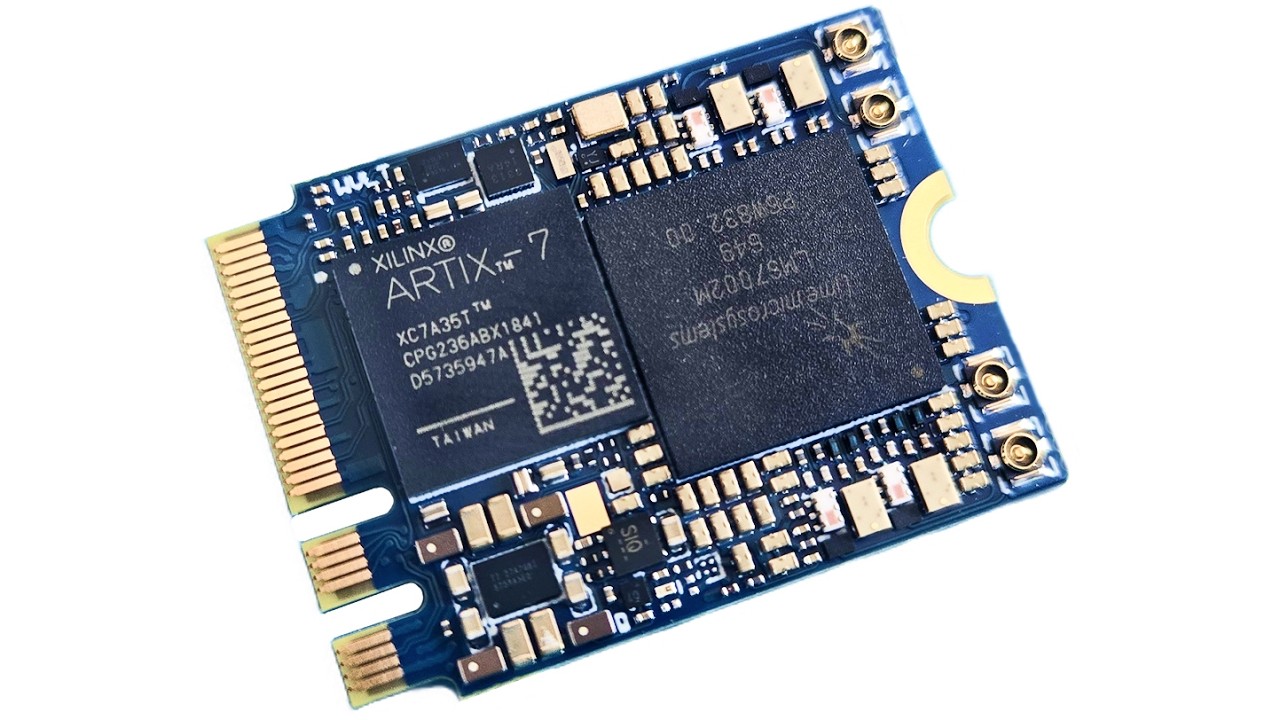
Wavelet Lab has opened crowdfunding for its xSDR, the more compact of two planned M.2 software defined radio modules built around Lime Microsystems’ LMS7002M field-programmable radio-frequency chip – the same as powers the LimeSDR range.
“Like uSDR, xSDR is built around simplicity, accessibility, and collaboration, now with expanded performance and flexibility,” Wavelet Lab’s Andrew Avtushenko promises of the new module, building on the team’s earlier work on the uSDR module. “xSDR is a compact, single-sided M.2 software-defined radio designed for seamless integration into modern computing platforms. The ‘x’ stands for extended, delivering extended bandwidth and multi-channel operation in the same minimal footprint that defined uSDR.
“You can configure and operate xSDR directly from a browser, and collaborate through cloud-based workflows using the wsdr.io platform. Build, control, and share RF applications without complex setup or driver overhead. xSDR preserves the embedded-first philosophy and compact form factor, while expanding RF capability and flexibility. It represents the next step forward, designed for users who need multi-channel operation, higher performance, and deeper integration into modern computing platforms.”
The xSDR delivers 2×2 multiple-input multiple-output (MIMO) receive/transmit with a 30MHz to 3.8GHz tuning range and up to 122.88 mega-samples per second sampling rate, using the Lime Micro LMS7002M and an AMD Artix-7 XC7A35T field-programmable gate array – all in a tiny M.2 module designed to add SDR support to a broad range of single-board computers, laptops, desktops, and servers. The company is also preparing to launch another campaign for the sSDR, an extended-coverage variant which adds a Lime Micro LMS8001 up/down converter for 30MHz to 11GHz coverage.
The xSDR crowdfunding campaign is live now on Crowd Supply, with hardware priced at $549 module-only.
Kris Slyka has built a working analogue TV transmitter, capable of both audio and video, out of an STMicroelectronics STM32 microcontroller – and almost nothing else.
“After looking around for a bit, realising that CRT TVs have gotten stupidly expensive, and finally picking up this adorable thing for €50 I found myself with a whole new technological rabbit hole to dive into,” Kris explains of the CRT display that inspired the project. “Turns out that one of the reasons this TV was so cheap was because it doesn’t have any video input besides an antenna. And it’s black and white. Both of which are deeply disappointing to gamers.
“And since analogue video broadcasts around here have stopped like a decade ago I couldn’t even enjoy our high quality domestic TV programming, let alone connect any of my weird cameras. So, there’s two options here, basically: either mod the TV for composite video input (not too hard) or just get an RF modulator (easy).
“OK, but what if I just built my own RF modulator (much harder!)? I dug through my pile of small dev boards and found a[n STMicro] NUCLEO-G431KB, a small development board for the STM32G431, a microcontroller which, according to ST, features ‘medium analogue level integration.’ That’s just the amount of analogue integration I was looking for!
“The main thing I though that might make this possible is the fact that the internal operational amplifiers on this chip support input muxing,” Kris notes, “allowing them to quickly switch between different input signals. If I could make them switch fast enough, well… that’s basically an RF modulator right there.”
The full write-up, which ends in the creation of a compact custom PCB capable of transmitting analogue audio and video – though at a strength that means you have to wrap a wire around the TV’s fixed antenna in order to see or hear anything but static – is available on Kris’ website.
Scientific and technical amateur radio specialist Daniel Estévez has been looking into the ESCAPE Mars orbiter mission again – this time revisiting the telemetry to see what new data could be extracted from recordings.
“Back in November, I posted about the ESCAPADE Mars twin orbiter mission. I made a recording of the X-band telemetry with the Allen Telescope Array the day after launch, and I decoded the telemetry with GNU Radio,” Daniel explains. “I made a preliminary analysis of the telemetry, showing that it contained a large number of log messages in ASCII.
“Shortly after writing this post, PistonMiner provided a deeper analysis of the telemetry, including a GitHub repository with some code and extracted data. She noticed that the CCSDS Space Packets, all of which belonged to the same APID 51, contained MAX simple telemetry frames in their payloads. Since MAX telemetry frames contain their own APIDs, this allowed separating the different types of telemetry data. Since seeing this, I wanted to go back and analyse again the telemetry to see what else I could find. Now I’ve finally had some time to do this.
“APID 520 contains asynchronous log messages,” Daniel writes of his findings. “The payload of the MAX frames is the log message in ASCII. APIDs 620, 621, 622 and 623 contain some ASCII strings. My guess is that these APIDs indicate the status of some tasks that are currently running, and they have string fields to list the name and state of task. APID 730, which is only active in ESCAPADE-Blue, contains a file path in ASCII, followed by some numeric data. APID 740 is used to downlink files. APIDs 6084 and 6423 [contain] quaternion data.”
The full write up, along with links to downloaded files, is available on Daniel’s website.
Marcin Brzozowski has showcased a work-in-progress project which turns a Raspberry Pi 5 single-board computer and suitable software-defined radio into a Terrestrial Trunked Radio (TETRA) base station: TetraSpot.
“TETRA [is] the digital radio standard used by emergency services, public safety, transport, etc. across Europe and beyond,” Marcin explains. “Think of it as the infrastructure behind police/fire/ambulance radio comms. Until now, running a TETRA base station required proprietary BTS software and expensive hardware. We built TetraSpot – an open alternative that runs entirely on a Raspberry Pi 5.
“What the Pi handles right now: voice calls (group + private, simplex and duplex); SDS messaging (like SMS for TETRA); terminal authentication; location reporting; group scanning; web management interface for audit logging and configuration; network bridging plugins to other protocols.
“Next hardware step,” Marcin says, “is swapping the SDR for [a more powerful unit] with a class A amp to push it to a full-size base station – but honestly it’s pretty wild what the Pi 5 can handle on its own.”
More information on the project is available in Marcin’s Reddit post and YouTube video demo; the software is currently in alpha status, with Marcin saying he plans to publish it under an as-yet unspecified open-source licence in the near future after further polish.
The Osmocom team has announced new updates in the Osmocom Cellular Network Infrastructure (CNI) project, bringing a range of bug-fixes and improvements across the software stack.
“[A] New libosmocore minor version 1.13.0 was released with main improvements,” Osmocom’s Pau Espin Pedrol announced of the updates. “Tons of fixes and improvements in osmo_io, gsmtap and logging. Log targets configured over VTY are now used in non-blocking synchronous mode by default. Improved feature detection and new flags available during configure time. Emscripten build support and JS callback logging backend.
“New osmo-bts minor version 1.11.0 was released with main improvements: lots of fixes and improvements around TA and BS/MS Power Loops. abis_osmo: Fix reading Abis IPA OSMO_EXT type. PCUIF now uses osmo-io and hence support io_uring backend. bts-trx: TRXD and TRXD now use osmo-io and hence support io_uring backend. bts-trx: trx_provision_fsm:: apply ‘max-initial’ value before POWERON.
“osmo-bsc, osmo-cbc and osmo-hnbgw [also] got new patch releases fixing several bugs and crashes,” Pau adds.
Pau’s announcement is available in full on the Osmocom blog.
Researchers have released the result of the largest ever radio sky survey, carried out by the Lofar telescope – covering a total of 13.7 million cosmic radio sources, including the most complete census yet recorded of actively-growing supermassive black holes.
“This data release brings together more than a decade of observations, large-scale data processing and scientific analysis by an international research team,” says Timothy Shimwell, lead author and astronomer at Astron and Leiden University, of the Lofar Two-metre Sky Survey (LoTSS-DR3) release.
“This map gives us a new look at the radio sky and at the history of the universe, and it almost makes you dizzy,” adds Chalmers astronomer Cathy Horellou. “Everywhere, Lofar sees traces of supermassive black holes, and now we have the opportunity to discover how much these active black holes have influenced the history of the universe.”
“The volume of data we handled – 18.6 petabytes in total – was immense,” says Thuringian State Observatory’s Aleander Drabent of the data crunched in order to produce the map, “and required continuous processing and monitoring over many years, using more than 20 million core hours of computing time.”
A paper detailing the data, the third release from the Lofar project, is to be published in the journal Astronomy & Astrophysics.
Finally, maker collective WyoLum has shown off a piece of functional art that decorates while doubling as a real-time satellite tracker: the Orbigator.
“The Orbigator is a kinetic art piece and precision instrument,” the group explains, “a two-axis servo-driven arm inside a 30 cm acrylic globe that points continuously at the International Space Station (or any tracked satellite) using real-time SGP4 orbital propagation.
“A Raspberry Pi Pico 2W runs a full SGP4 orbital propagator in MicroPython. Every second it fetches the current satellite position using a cached Two-Line Element (TLE) set downloaded from CelesTrak. The result — inclination angle and right-ascension angle — is sent to a pair of Dynamixel XL330 servo motors via RS-485, driving a two-axis gimbal arm inside the globe to point directly at the satellite.
“Full credit to WillsBuilds on YouTube, who built a stunning 8-inch magnetic ISS tracker that really sparked the idea,” the group adds. “His build is beautiful — we highly recommend watching it. The Orbigator set out to solve two specific limitations of that design: The globe rotates around the mechanics.
“The key design inversion: rather than an arm pointing out from fixed electronics, the Orbigator puts the two-axis gimbal inside the acrylic globe, and the globe itself turns on the EQX (azimuth) axis as part of the mechanism. The sphere is simultaneously the display and the tracker — no cable fighting rotation. Continuous tracking, no rewind. Because the globe turns continuously with the satellite, the arm never needs to reset or skip. The ISS orbits indefinitely and the Orbigator follows every pass without interruption.”
The full project write-up is available on the WyoLum website; source code and hardware design files are available on GitHub under the permissive MIT licence.